By Elena From TenShades & Me
Making Disability And BDSM Work
Firstly, a huge thank you to the wonderful Mistress Claudia Sky for inviting me to share my story, and to talk about disability and BDSM, some of the ways that we can accommodate disability and other health conditions in our kink play.
My name is Elena, I am a disabled polyamorous submissive and the author and owner of Ten Shades & Me. I started writing about BDSM in 2015, but with a twist – I knew that I wanted to make BDSM accessible for the people like me who don’t have perfect bodies.
I was born with a variety of health conditions, including arrested hydrocephalus (too much water on my brain), spina bifida, mild hearing loss and ataxia. Later in life I also developed causalgia – a chronic pain condition – in my right wrist, knee and foot. Although I seem “normal” to most people, and I live a fairly independent life, I do still need some aids and adaptations – including in my BDSM play.
For me, one of my biggest needs is a pillow behind my head if I am laid on my back. Because of my ataxia I am prone to dizzy spells and nausea, and elevating my head slightly helps to prevent that. Also, because of my chronic pain and the skin sensitivity associated with it, I need to not have a cuff applied to my right wrist, or be grabbed by it. My Dominants are used to adapting our BDSM play to suit me.
In my past, I have also met and played with other kinky people with health conditions, including a wheelchair-using Dominant, a Dominant who had hemodialysis three times a week, and a switch with cerebral palsy and epilepsy. This is not a kink for me: disabled people understand disabled people better. We’re less judgemental of others’ broken bodies.
But I am not the only kinky person with health conditions, in fact, it is estimated that roughly one in six people has a disability or health condition. That means that you, or someone you know, likely has to accommodate a medical need in the bedroom, too.

So how can we do that in our BDSM play?
Talk To Them About Their Needs
All good things start with communication, and that means having a conversation about your partner’s condition and the things they need to accommodate it. Talking about disability and sex can be challenging, but there really is no shame in needing some support to live a more pleasurable life. Don’t bombard your partner with the conversation, pick a time and a place where you can both be comfortable and relaxed.
Learn Your Partner
When dealing with a health condition, it is absolutely vital that you both understand one another, because health conditions can affect people (and their partners) in a myriad of ways. They can have more energy one day than the next, for example, or be able to take more pain one day than the last. Understand their limits, their needs, their no-go zones, their triggers, their condition. Understanding is the key to a deeper, stronger bond.
Get Realistic About Your BDSM Play
Understand that your BDSM will likely look a little different from the norm, and that’s okay. As it is said, “normal” is a setting on a washing machine – your BDSM will work however it works for you and your partner, as your condition allows. Stop focusing on fictional examples of BDSM, and focus instead on one another.
Establish Safety Signals That Work
A lot of people get caught up on safewords and the traffic light system (“red” for stop, “yellow” for “slow down” etc), but the most important thing is that any signal you have works for both of you. If your partner is non-verbal, for example, you could have them hold a bunch of keys that they drop if they need to stop. If they are prone to memory lapses, use a word that is easy to remember, or learn the signs that they may be approaching their limit, and check in.
Make Your BDSM Safer
Are they epileptic? Consider quick-release restraints (such as quick-release knots, or velcro cuffs) so you can release them quickly in the event of a seizure. Are they diabetic? Agree to make blood sugar monitoring an important protocol for both their welfare and the welfare of the dynamic. Do they have arthritis or chronic pain? Don’t keep them in positions for too long, use support cushions, and incorporate pain relief and massage into your aftercare if necessary. BDSM is supposed to be pleasurable!
Make Your Aids Sexier
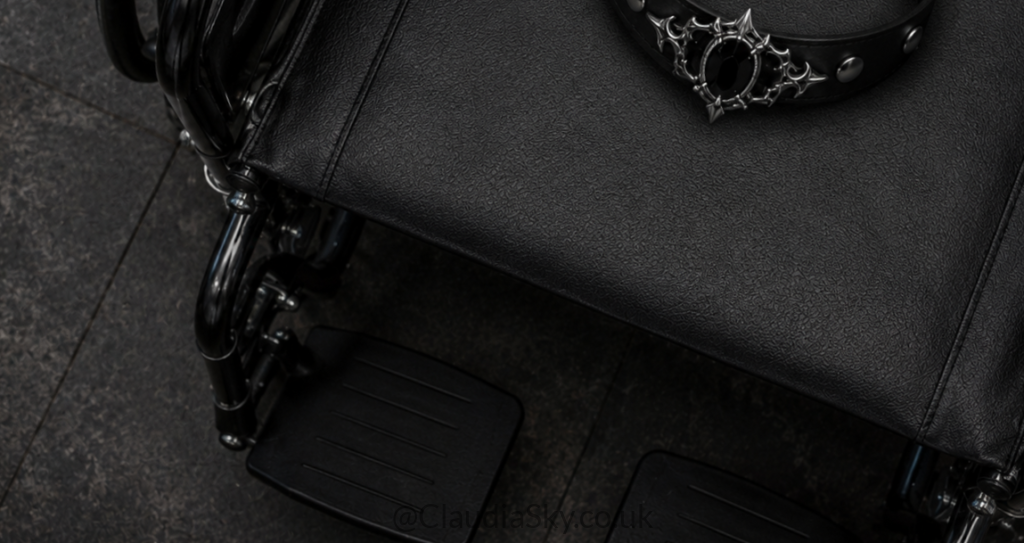
When I was in my teens, I wrapped my crutches in holographic foil – anything to make them look a bit snazzier than standard issue, NHS aids! In a similar way, you can make aids feel more attractive too, whether jazzing them up with covers, drapes, fabrics, stickers etc. Personalise them – make them as fabulous and as individual as you are!
Don’t Rush In
Listen, it’s easy to want to dive in and go full-throttle in your BDSM play, but that can be a recipe for disaster, especially when you have a disability or health condition. You will need to go slower (and maybe gentler) than some other people – and that’s okay! Check in with your partner often, gauge their comfort both mentally and physically. You will be able to explore your limits a lot safer if you don’t rush them to begin with.
Read Examples Of Other Disabled BDSM Practitioners
I am but one voice in an ever-growing population of disabled kinksters, and every person has a different story and different experiences to share. So why not learn from them, and discover how they accommodate their conditions in their BDSM?
My top two recommended books on this topic are Hell on Wheels: Disabled Dominants and Kneeling In Spirit: Disabled Submissives, both by Raven Kaldera. Both are reasonably priced, available on Amazon and contain real-life examples of accommodating disability in BDSM.
I hope that this post has been helpful and insightful for you. As always, thank you for reading me. If you would like to read more of my writings, you can visit me at www.tenshadesandme.co.uk.
If I can be of assistance or you would just like to get in touch, you can email me at tenshadesandme@gmail.com.