
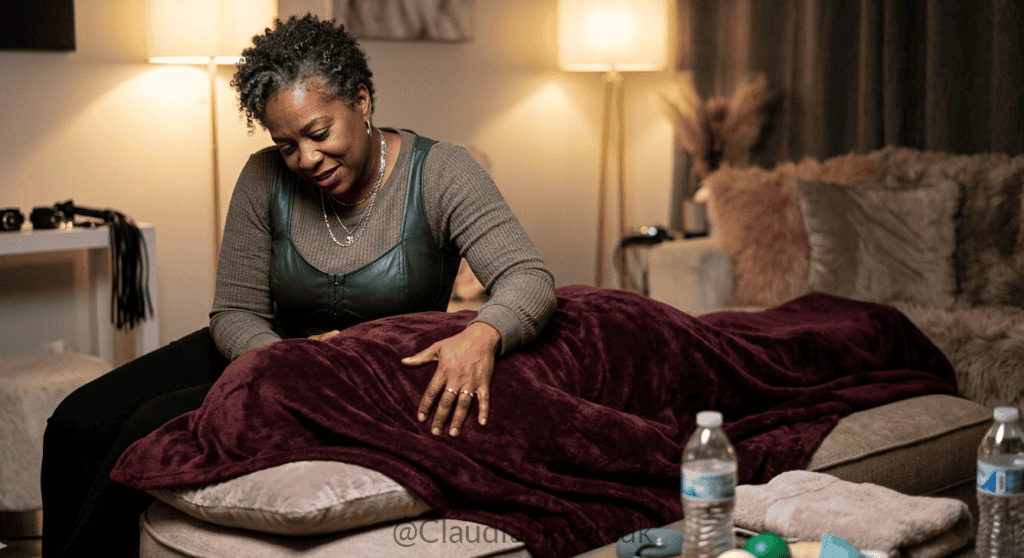
By Dominatrix Mistress Claudia Sky
Ask most people what happens at the end of a BDSM session and they’ll describe the obvious: the scene ends, things are put away, people get dressed, goodbyes are said. What they leave out — what a surprising number of dominatrices leave out — is the most important part of the entire experience. This article explains what aftercare in BDSM actually is and why it’s an essential ingredient of play.
Aftercare. If you’ve never heard the term, this article will explain it. If you have heard it but aren’t sure what it really involves or why it matters, this article will go deeper than most. And if you’re considering seeing a professional dominatrix and wondering what separates the genuine practitioners from the people simply playing a role — aftercare is one of the clearest answers to that question.
What is aftercare in BDSM?
Aftercare is the intentional care provided to everyone involved in a BDSM scene after the scene ends. It is the process of coming down — physically, psychologically, and emotionally — from an experience that may have been intense, disorienting, exhilarating, frightening, or all of those things simultaneously.
Aftercare is not a nicety. It is not optional. It is not something you graduate past once you become more experienced. It is a non-negotiable component of any responsible BDSM session — and its absence is one of the clearest signs that the person running the scene doesn’t really know what they’re doing.
What happens to your body and brain during a BDSM session
During an intense session, your body is flooded with chemicals. Endorphins — the same compounds released during hard physical exercise — surge in response to pain, restraint, and adrenaline. Dopamine, the brain’s reward chemical, spikes in response to pleasure, anticipation, and the particular charge of surrendering control. Oxytocin releases during physical closeness and touch. Cortisol and adrenaline flood the system in response to fear and intensity.
The result is a state that regular BDSM practitioners often call subspace: a floating, altered quality of consciousness in which pain may feel diminished, ordinary concerns recede, and the submissive is entirely present in the moment. For many people, reaching subspace is the entire point of the session. It is deeply pleasurable. It is also profoundly vulnerable. And then the scene ends. The chemicals don’t disappear instantly. They drop. And when they drop, the person who was floating a few minutes ago can find themselves cold, quiet, disoriented, tearful, or emotionally raw in ways they don’t immediately understand. This is not a sign that something went wrong. It is a sign that something went right — and that the body now needs help landing. Aftercare in BDSM play makes the difference.
What is sub-drop — and why it matters
Sub-drop is the term for the emotional and physical crash that can follow an intense BDSM scene. It is caused by the rapid decline of all those elevated hormones — the same mechanism behind the low that some people feel after extreme exercise, or after a period of high stress suddenly resolving.
Sub-drop can feel like sadness without a specific cause. It can feel like flatness, disconnection, or a quiet but persistent sense of something being wrong. It can arrive immediately after a session, or it can surface hours or even days later — sometimes catching people completely off guard when they thought they were fine.
How long does sub-drop last?
Sub-drop varies significantly from person to person and from session to session. A mild drop might last a few hours. After a particularly intense scene — one that pushed into genuinely deep psychological territory — it can linger for several days. There is no reliable formula. What matters is knowing it can happen, recognising it when it does, and having a plan.
Signs you’re experiencing sub-drop
Unexplained sadness or low mood in the hours or days after a session. A sense of emotional flatness or disconnection. Feeling unusually tired, irritable, or fragile. Questioning whether the session was a good idea, or feeling a vague shame that wasn’t present during the experience itself. If any of these arrive after an intense session, sub-drop is a very likely explanation — and the antidote is rest, gentleness, and time.
What aftercare in BDSM actually looks like
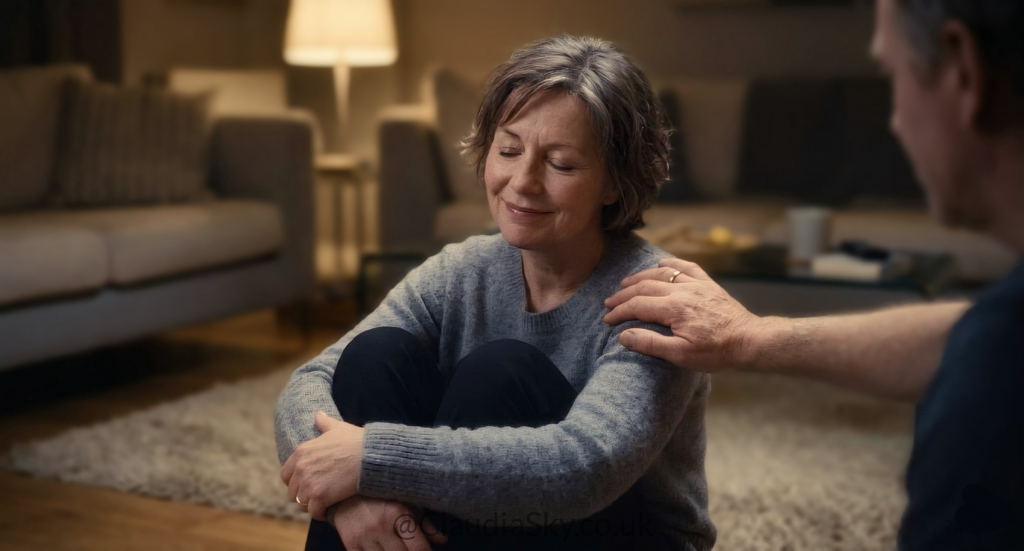
Aftercare looks different for every person and every session. It is most effective when it has been discussed in advance — when the submissive has already communicated what they will need, and the dominant has listened and prepared accordingly.
Common forms of aftercare include: physical warmth — a blanket, a warm drink, closeness — because body temperature often drops after intense sensation play or restraint. Verbal reassurance — being told that the session was good, that they did well, that they are safe. Gentle physical contact: holding, stroking, quiet proximity. Water and something light to eat, to help stabilise blood sugar and return the body to equilibrium. Time — simply sitting together, without pressure or expectation, while the nervous system finds its way back.
For some people, aftercare is the quietest, most intimate part of the entire experience. The sub is in a soft and open state, closer to their own vulnerability than they are in almost any other moment of their lives. The slow landing from a good aftercare experience can be profoundly beautiful. Some clients tell me they look forward to aftercare as much as the session itself. I understand that entirely.
The part nobody talks about: dominants need aftercare in BDSM, too
This is almost completely absent from mainstream conversations about BDSM, and it matters. Dominant participants also experience significant physiological and emotional shifts during an intense scene. The focus, control, and responsibility required to run a session — to read another person in real time, to push limits carefully and attentively, to make constant judgements about what is happening and what is needed — is demanding in ways that are not always visible from the outside.
What is dom-drop?

Dom-drop is the dominant’s equivalent of sub-drop — a comedown characterised by fatigue, emotional flatness, mild guilt, or a sense of deflation after the high of running an intense scene. It is talked about far less than sub-drop, partly because there is still a cultural expectation that dominants are somehow above emotional vulnerability. The reality is that dom-drop is real, it is common, and it is nothing to be managed alone or in silence.
How I ground myself after an intense session
Every dominant who has been doing this for a while develops their own way of coming back to themselves after a session. For me, it involves a deliberate transition: time to decompress before moving back into ordinary life, something grounding and physical — a walk, food, warmth — and usually a period of quiet. I have been in the kink community for over twenty-five years. I know what an intense session takes out of me, and I know how to take care of myself afterwards. A dominant who has no aftercare practice of their own is running on fumes — and the people in their care will eventually feel the difference.
No aftercare is a red flag — full stop
A dominatrix who does not provide aftercare in BDSM sessions, who dismisses it as unnecessary, who ends a session abruptly and leaves a submissive to manage their own comedown without support — is not a skilled practitioner. Aftercare in BDSM is not an optional extra that you earn through experience or unlock at a certain level of kink. It is a fundamental responsibility. Its absence in a professional context is not edgy, or hardcore, or a sign of a particularly strict dynamic. It is simply bad practice — and in some cases it is genuinely harmful.
If you are researching dominatrices and you want to know whether the person you’re considering sees the full scope of their responsibility — ask them about aftercare. See what they say. Their answer will tell you almost everything you need to know about who they actually are in that room.
Aftercare in a professional session — what to expect with Mistress Claudia Sky
Aftercare in BDSM play is built into every session I run. It is not an afterthought. It is discussed in the initial consultation, tailored to the individual, and treated as part of the session — not separate from it.
I have been a submissive. I know what it feels like to come out of an intense scene and need to land slowly, safely, in the presence of someone who is still paying attention. I know the particular quality of vulnerability that arrives when the adrenaline fades and the brain chemicals begin to drop. That experience informs everything about how I hold space for my clients after a session ends.
You will not be rushed. You will not be left to manage alone. The session is not over until you are grounded, comfortable, and genuinely ready to leave. Sub-drop can also arrive later — sometimes the day after a session, sometimes two or three days on. If that happens, I am available for a brief check-in. A session is an experience. Experiences need to be held, from beginning to end.
Enquire about a session with Mistress Claudia Sky.
Frequently Asked Questions
What is aftercare in BDSM?
Aftercare is the care provided to everyone involved in a BDSM scene after the scene ends — physical comfort, emotional reassurance, and time to transition from the intensity of the session back to everyday life.
What is sub-drop?
Sub-drop is the emotional and physical comedown that can follow an intense BDSM session, caused by the rapid decline of hormones like endorphins, dopamine, and adrenaline. It can feel like sadness, flatness, or unexplained vulnerability, and can arrive hours or even days after a session.
Do dominants experience sub-drop?
Yes — this is known as dom-drop. Dominants experience their own emotional and physiological shifts during and after a scene, and their need for aftercare is just as real, if less frequently discussed.
Does a professional dominatrix provide aftercare?
A skilled, experienced professional dominatrix will always provide aftercare. Its absence is a significant red flag about the quality and responsibility of the practitioner.
How long does sub-drop last?
It varies significantly. A mild drop may last a few hours. After an intense session involving deep psychological play, it can linger for several days. Knowing it can happen — and having support when it does — makes a significant difference.
What should aftercare in BDSM look like after a professional dominatrix session?
It should include time to decompress, physical comfort, verbal reassurance, and the knowledge that the session is not considered over until the submissive is genuinely grounded and ready to leave. A good dominatrix will also make herself available for a check-in if sub-drop arrives in the days following.